









|
|
|
|
|
|
|
|
|
|
|
|
|
|
|
|||||||||||
|
|
|
||||||||||
|
|
|
||||||||||
|
|
|||||||||||
|
|
|
|
|
|
|
|
|
|
|
||
|
|
|||||||||||
Long before humans arrived in North America there was fire. It came with the first lightning strike and will remain forever. Unlike earthquakes, tornados, and wind, fire is a disturbance that depends upon complex physical, chemical, and biological relationships. Wildland fire is inherently neither good or bad, but it is the most powerful natural force that people have learned to use. As an inevitable natural force, it is sometimes unpredictable and potentially destructive, and along with human activities has shaped ecosystems throughout time.
Early ecologists recognized the presence of disturbance but focused on the principle that the land continued to move toward a stable or equilibrium condition. Through the years, however, scientists have acknowledged that equilibrium conditions are largely the exception and disturbance is generally the rule. Natural forces have affected and defined landscapes throughout time. Inasmuch as humans cannot completely control or eliminate these disturbances, ecosystems will continue to change.
Human activities also influence ecosystem change. Native Americans actively used fire in prehistoric and historic times to alter vegetation patterns. In short, people and ecosystems evolved with the presence of fire. This human influence shifted after European settlement in North America, when it was believed that fire could and should be controlled. For many years, fire was aggressively excluded to protect both public and private investments and to prevent what was considered the destruction of forests, savannahs, shrublands, and grasslands. While the destructive, potentially deadly side of fire was obvious and immediate, changes and risks resulting from these fire exclusion efforts were difficult to recognize and mounted slowly and inconspicuously over many decades.
There is growing recognition that past land use practices, combined with the effects of fire exclusion, can result in heavy accumulations of dead vegetation, altered fuel arrangement, and changes in vegetative structure and composition. When dead fallen material (including tree boles, tree and shrub branches, leaves, and decaying organic matter) accumulates on the ground, it increases fuel quantity and creates a continuous arrangement of fuel. When this occurs, surface fires may ignite more quickly, burn with greater intensity, and spread more rapidly and extensively than in the past. On the other hand, uses such as grazing can sometimes reduce fine fuels, precluding periodic surface fires that would typically burn these areas. Without fire, encroachment of woody species may occur in some savannah and grassland ecosystems.
The arrangement of live vegetation also affects the way fires burn. For example, an increase in the density of small trees creates a multi-storied forest structure with a continuous vertical fuel arrangement. This arrangement may allow a fire normally restricted to the surface to spread into the trees and become a crown fire. In addition to structural changes, vegetation modification resulting from fire exclusion can cause a shift toward species that are not adapted to fire (some of which are not native) and are therefore more susceptible to damage from fire. Fire exclusion sometimes favors non-native species in some fire dependent areas, while in other areas fires may encourage non-native species.
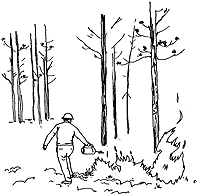 Fires in areas of altered vegetation and fuels can adversely affect other important
forces within an ecosystem, such as insects and disease, wildlife populations,
hydrological processes, soil structure and mineralogy, and nutrient cycling.
Any of these components, if altered greatly by usually severe fire, can seriously
diminish the long-term sustainability of the land. In addition, effective protection
from, and control of these large fire events will likely be much more difficult.
Fires in areas of altered vegetation and fuels can adversely affect other important
forces within an ecosystem, such as insects and disease, wildlife populations,
hydrological processes, soil structure and mineralogy, and nutrient cycling.
Any of these components, if altered greatly by usually severe fire, can seriously
diminish the long-term sustainability of the land. In addition, effective protection
from, and control of these large fire events will likely be much more difficult.
Paradoxically, rather than eliminating fire, exclusion efforts, combined with other land use practices, have in many places dramatically altered fire regimes (circumstances of fires, including frequency, intensity, and spatial extent) so that today's fires tend to be larger and more severe. No longer a matter of slow accumulation of fuels, today's conditions confront us with the likelihood of more rapid, extensive ecological changes beyond any we have experienced in the past. To address these changes and the challenge they present, we must first understand and accept the role of wildland fire and adopt land management practices that integrate fire as an essential ecosystem process.
While other techniques, such as mechanical removal, may be used to reduce heavy fuels, they cannot always replace the ecological role that fire plays. Fire not only reduces the buildup of dead and downed fuel, it performs many other critical ecosystem functions. Fire can recycle nutrients that might otherwise be trapped for long periods of time in the dead organic matter that exists in many environments with slow rates of decay. It can also stimulate the production of nutrients and improve the specific conditions, including seed release, soil, light, and nutrients, that are critical for the reproduction of fire-dependent species.
Although ecological knowledge and theories have evolved relatively quickly, the scope and process of land management have had difficulty keeping pace. Ecological processes, including fire and other disturbances, and changing landscape conditions are often not integrated into land management planning and decisions. With few exceptions, existing land management planning is confined within individual agency boundaries and is based on single-program goals that are driven by agency missions and policies. Separate incompatible planning systems can also preclude the ecosystem perspective in land management planning. This type of planning can result in an inefficient, fragmented, short-term approach to management that tends to ignore broad, interdisciplinary-based, long-term resource issues that cross agency boundaries. Land management agencies now recognize these barriers and seek cooperative, ecologically sound approaches to land management on a landscape scale.
One way to break down these barriers is to involve all interests, including the public, scientists, resources specialists, and regulators, throughout the planning process. Another is to establish a clear link for communication and information transfer between scientists and managers. These measures will help to ensure that management needs are met and that current science is used in land management planning at all levels.
Planning must also consider the risks, probabilities, and consequences of various management strategies, e.g., fire versus fire exclusion. In a responsive planning process, management decisions must be monitored, integrated, and supported at each step. In order to carry out critical and effective "adaptive management" (a feedback approach to management that uses monitoring results to plan future actions), planners and managers need a nationwide baseline measure of ecological conditions and a compatible method of assessing long-term ecological health by ecosystem type.
We must understand and accept the need to integrate wildland fire into land management plans and activities, and this integration must be reconciled with other societal goals, e.g., maintaining species habitat, producing commodities, and protecting air quality, water quality, and human health. Laws and regulations must consistently address long-term ecosystem processes and must guide agencies toward a common goal. Information about the consequences of various management strategies is not currently working toward and prioritizing simultaneous goals. Land management and regulatory agencies must interact and collaborate and must rely upon a continuous process of public involvement and feedback to achieve a balance of ecosystem and other societal goals.
Several factors hinder the reintroduction of wildland fire on an ecologically significant scale. Even now it sometimes takes years to reach agreement about appropriate treatments and to take action. Land managers often feel the need to wait for scientific certainty before acting. This favors the status quo, impedes progress, and deters investigation of new techniques. In some ecosystems, little or no information is available about disturbance regimes, historical fire patterns, response to past management actions, and likely future responses. Information needed to reintroduce fire includes a well-planned, large scale scientific assessment of current ecosystem conditions and the consequences of various management strategies.
Another constraint is that fire management plans are not in place in all areas, thus precluding managers from taking advantage of the management options presented by wildland fires. Planning should consider all wildland fires, regardless of ignition sources, as opportunities to meet management objectives. In areas where planning has determined a range of appropriate management actions for the use of wildland fire, there will be more opportunities to safely and cost-effectively reintroduce fire. This approach will also make suppression resources available for the highest-priority situation. All wildland fire management actions will continue to be based on values to be protected, fire and land management objectives, and environmental conditions. In many situations, such as fires occurring in highly developed areas or during particularly severe weather, immediate initial attack and prompt suppression will still be required.
An additional contributing factor is the increasing human settlement that encroaches upon wildlands (wildland-urban interface). Such development divides and fragments wildlands, making it difficult to apply ecosystem-based management strategies. This increases the risk of escaped fire and generates complaints about smoke and altered scenic values. In these areas, the use of fire may be limited in spatial extent and, even where fire introduction is desirable, progress may be slow.
Smoke is perceived as a factor that may affect land managers' ability to use larger and more frequent wildland fire for restoration and maintenance of fire-dependent ecosystems. Several federal air quality programs under the Clean Air Act (CAA) regulate wildland fire emissions. The Environmental Protection Agency (EPA) is required to set air quality standards for pollutants that affect public health. States are then required to submit plans to ensure measures will be taken to meet those air quality standards. Local areas may also develop plans that may be more (but not less) restrictive than state and national standards.
In areas where air quality standards are violated, measures must be taken to reduce emissions. Emission control measures for fires that are used to meet management objectives include smoke management techniques that minimize and disperse smoke away from smoke-sensitive areas. Smoke from fires may also cause standards to be exceeded in communities miles away from the source. Currently, prescribed fires are not considered to be a significant cause of non-attainment, but with increased burning to reduce fuels and restore or maintain ecosystem health, this may change. In many areas, fire managers and local air quality authorities have successfully worked together to accomplish fire and land management objectives, resolve conflicts with smoke emissions, and avoid violation of air quality standards. With guidance from the national level to provide consistent interpretation, further cooperation at the local level will help to achieve a balance of air quality and other ecosystem goals.
Fire is a unique tool that land managers can use to complement agency missions and land management objectives. But in order to successfully integrate fire into natural resource management, informed managers, partners, and the public must build upon sound scientific principles. Before fire is applied on an ecosystem-scale, an understanding of historic fire regimes, as well as a knowledge of the current conditions of each system, is needed. Then all parties must work together in the land management planning and implementation process according to agreed-upon goals for the public welfare and the health of the land.
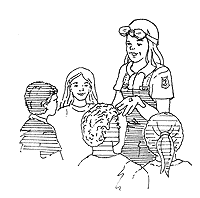 For many people, fire remains a fearsome, destructive force that can and should
be controlled at all costs. Smokey Bear's simple, time-honored "only you" fire
prevention message has been so successful that any complex talk about the healthy,
natural role of fire and the scientific concepts that support it are often lost
by internal and external audiences. A comprehensive message is needed that clearly
conveys the desired balance of avoiding fires with adverse affects while simultaneously
increasing ecologically beneficial fire.
For many people, fire remains a fearsome, destructive force that can and should
be controlled at all costs. Smokey Bear's simple, time-honored "only you" fire
prevention message has been so successful that any complex talk about the healthy,
natural role of fire and the scientific concepts that support it are often lost
by internal and external audiences. A comprehensive message is needed that clearly
conveys the desired balance of avoiding fires with adverse affects while simultaneously
increasing ecologically beneficial fire.
The ecological and societal risks of using and excluding fire have not been adequately clarified and quantified to allow open and thorough discussions among managers and the public. Few understand that integrating fire into land management is not a onetime, immediate fix but a continual, long-term process. It is not an end in itself but a means to a more healthy end. Full agency commitment to internal and external information and education regarding fire and other ecological processes is needed. Adaptive and innovative fire and land management is severely limited when agency employees and the public misunderstand or remain skeptical about the role of fire.
The task before us–reintroducing fire–is both urgent and enormous. Conditions on millions of acres of wildlands increase the probability of large, intense fires beyond any scale yet witnessed. These severe fires will in turn increase the risk to humans, to property, and to the land upon which our social and economic well-being is so intimately intertwined.
Goals
Actions
Federal agencies will:
Goal
Actions
Federal agencies will:
Goal
Actions
Federal agencies will:
U.S. Department of the Interior and U.S. Department of Agriculture. 1995. "Role of Wildland Fire in Resource Management." In Federal Wildland Fire Management: Policy & Program Review, Final Review. pp. 7-12.